If you’ve spent years in a workshop pulling apart office chairs, testing every adjustment mechanism, and watching how different bodies interact with seat geometry, you develop opinions fast. The most important one is this: the “best” ergonomic office chair is never one-size-fits-all. It’s the chair that keeps your spine supported, your hips level, and your focus where it belongs: on the work.
The demand for quality office chairs has surged in ways that would have surprised even the most optimistic manufacturers a decade ago. Remote work arrangements now account for a significant share of full-time employment, and with that shift has come a wave of people realizing their dining room chair wasn’t designed for eight-hour workdays. Studies show that American office workers sit for an average of roughly 10 hours per day when you factor in both work and leisure time, and that number has quietly driven a boom in ergonomic investments.
What makes a chair genuinely good for comfort and support comes down to three things in my experience: how well it fits your body, how much it can adapt over time, and how durable it proves to be once the newness wears off.
What Defines Comfort and Support in an Ergonomic Office Chair?
Comfort Factors
Comfort is not just about softness. Anyone who’s sunk into an overstuffed foam seat and emerged two hours later with a numb tailbone knows that plush doesn’t automatically mean comfortable. True seating comfort comes from cushioning that maintains its shape, breathable materials that prevent heat buildup, and a seat pan large enough to distribute weight without creating pressure points.
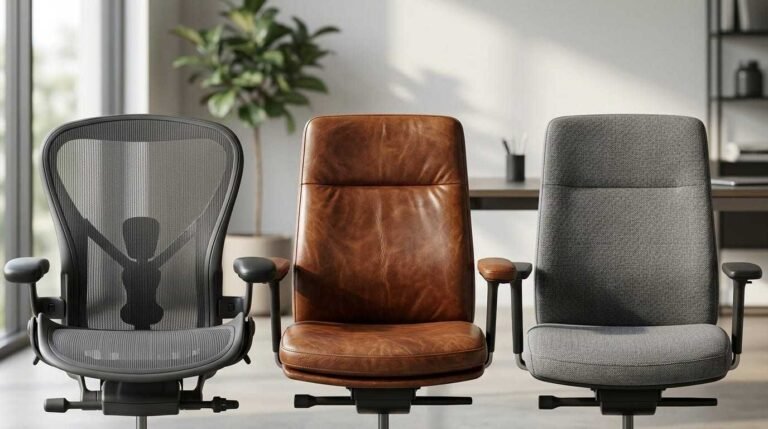
Mesh backs dominate ergonomic design for good reason. They allow airflow in ways that leather and standard foam cannot match, which matters enormously during long hours. Mesh quality varies wildly, though. A tightly woven, high-tension mesh holds its shape for years; a loosely constructed one sags within months and creates the uneven pressure it’s supposed to prevent.
Seat depth is something far too many buyers overlook. You should be able to sit fully back against the lumbar support with about two to three fingers of clearance between the seat edge and the back of your knees. Too deep and you’ll either slouch forward or lose lumbar contact entirely.
Support Features
Lumbar support is where ergonomic chairs earn or lose their reputation. Fixed lumbar supports work well for people whose proportions happen to align with the manufacturer’s assumptions, and that’s a narrow demographic. Adjustable lumbar support, where you can move the pad up or down and often control its firmness, serves a far wider range of body types reliably.
A well-designed backrest follows the natural S-curve of the spine, supporting the lumbar region without forcing an exaggerated arch. Headrests are genuinely useful for people who recline frequently but can create awkward neck positioning for those who stay upright most of the day.
Adjustability for Personalized Comfort
The adjustment points that matter most, in rough order of importance, are seat height, lumbar position, armrest height, and seat depth. A chair with four or five well-executed adjustments will serve most people better than one with twelve mediocre ones. Research in ergonomics literature consistently shows that properly fitted seating reduces reported discomfort and musculoskeletal fatigue significantly. The key word there is “properly fitted.” A high-end chair used at the wrong height with armrests in the wrong position is not ergonomics; it’s expensive guessing.
Benefits of Choosing the Right Ergonomic Chair
Better posture and spinal alignment reduce compressive forces on intervertebral discs, which translates directly to less lower-back pain over time. Reduced tension in the neck and shoulders follows naturally when your upper spine is supported and your arms have somewhere to rest.
The productivity connection is real. When you’re not shifting constantly to relieve discomfort, your attention stays on the task in front of you. Chronic back pain is among the leading causes of workplace absence in the United States, and a meaningful portion of those cases trace back to years of poor seating posture.
A quality ergonomic chair is, in that sense, a health investment with compounding returns. The benefits don’t stop at physical comfort; sustained focus leads to sharper output, fewer errors, and a more consistent work rhythm throughout the day. Over months and years, the difference between sitting in a chair that supports your body and one that works against it adds up in ways that show in your energy levels, your mood, and ultimately your performance. For remote workers and office professionals alike, the chair you spend eight or more hours in each day deserves the same consideration you’d give any serious tool in your workflow. Getting it right isn’t a luxury — it’s a practical decision that pays for itself.
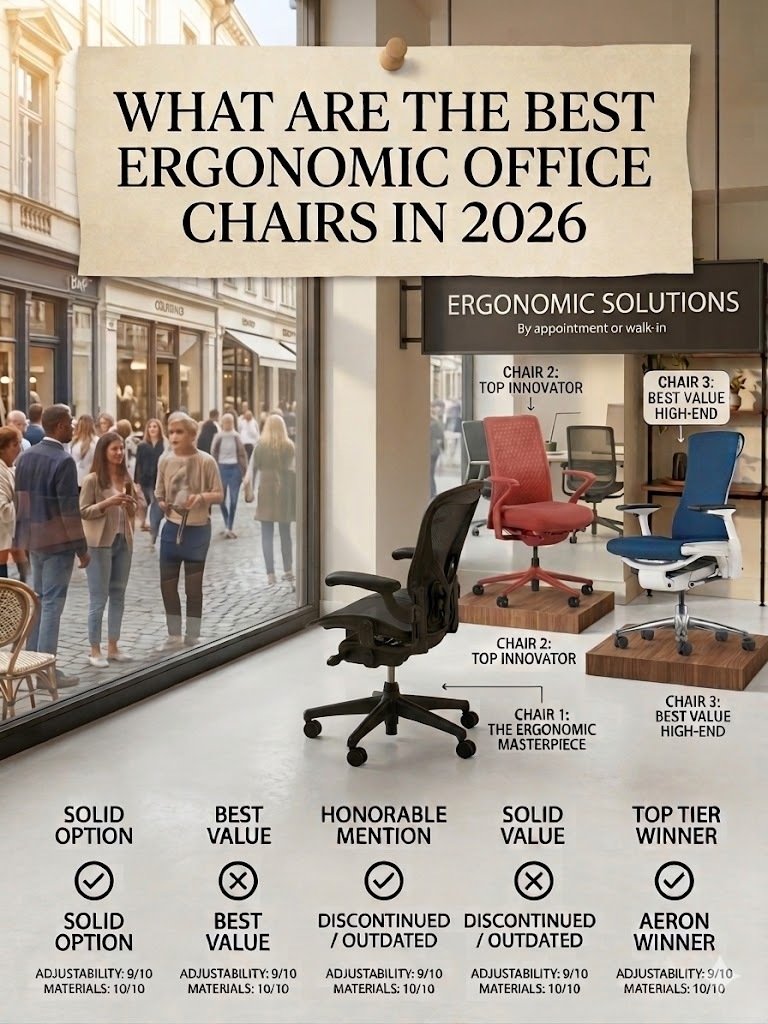
Best Ergonomic Office Chairs for Comfort & Support in 2026
Herman Miller Aeron – Best for All-Day Seated Work
The Aeron is the chair that most people in my field measure everything else against. Its PostureFit SL lumbar system supports both the sacrum and the lumbar spine simultaneously, which is genuinely different from most lumbar pads that address only one region. The 8Z Pellicle mesh distributes weight evenly across the seat and back, reducing pressure points better than any foam equivalent I’ve handled.
The Aeron comes in three sizes (A, B, and C), setting it apart from competitors who offer a single size and call it universal. This alone makes it one of the most practically useful chairs on the market for a diverse range of body types.
Pros: Exceptional breathability, proven durability, size options for different builds, strong resale value.
Cons: Premium price point, no headrest on standard models.
Price range: $1,400 to $1,900 new; refurbished models from $400 to $900.
Steelcase Leap V2 – Best for Dynamic Sitters
Where the Aeron suits people who sit relatively still, the Leap V2 was designed for people who move. Its LiveBack technology flexes and changes shape as your posture shifts. The natural glide system allows recline without the usual sensation of being pushed forward. The chair uses a flexible polymer backrest rather than mesh, so airflow is slightly reduced, but the comfort across position changes more than compensates for most users.
Pros: Superior movement accommodation, excellent lumbar customization, very well-made.
Cons: Less breathable than mesh alternatives, takes time to dial in all adjustments.
Price range: $1,300 to $1,700 new; refurbished from $350 to $800.
Humanscale Freedom – Best for Recliners
The Freedom chair takes a different approach. Rather than offering extensive manual adjustments, it uses the sitter’s body weight to calibrate recline tension automatically. The pivoting headrest stays in contact with your head as you recline, which sounds like a small detail until you try every other headrest that loses contact the moment you lean back.
Pros: Genuinely intuitive to use, excellent headrest, clean aesthetic.
Cons: Less adjustability than competitors at the same price, not ideal for primarily upright workers.
Price range: $1,200 to $1,600.
Sihoo Doro S300 – Best Value Ergonomic Option
Not every budget stretches to four figures, and the Sihoo Doro S300 is the best answer I’ve found in the mid-range. Dual dynamic lumbar support adjusts with your movement, and the anti-gravity recline is smooth. Build quality isn’t on par with Herman Miller or Steelcase, but it’s significantly better than most chairs in this price bracket.
Pros: Accessible price, solid lumbar support, excellent breathability.
Cons: Long-term durability remains to be proven over years of heavy use.
Price range: $400 to $600.
Neutral Posture Big & Tall Series – Best for Larger Body Types
Standard chairs routinely fail users above 250 pounds or over 6’2”, and that failure is felt as pressure on the hips, inadequate seat depth, and lumbar supports positioned too low. Neutral Posture’s big and tall models address these gaps directly with wider seat pans, higher weight capacities, and taller backrests calibrated to larger proportions.
Pros: Properly engineered for larger builds, not just a standard chair with a higher weight rating.
Cons: Heavier and bulkier by design, fewer finish options.
Price range: $700 to $1,200.
Ergonomic Chair Buying Guide: Choosing for Comfort & Support
How to Choose Based on Your Work Style
Someone spending ten hours a day in focused, upright desk work needs different things from a chair than someone who moves frequently or works in a reclined position for portions of the day. Before evaluating any specific model, be honest about how you actually sit, not how you intend to sit.
Long-hour users should prioritize lumbar adjustability and seat material breathability above almost everything else. Occasional home office use can reasonably trade some adjustability for budget without a meaningful ergonomic penalty.
Matching Chair Features to Body Type
Height and weight directly determine which chairs will actually fit you. A chair sized for someone 5‘8” at 170 pounds will not work well for someone 6’4” at 280 pounds, regardless of how many adjustments it offers. Before purchasing, check chair ergonomics measurements such as seat width, seat depth range, backrest height, and weight capacity to make sure the chair suits your body and workspace. Resources like the chair-fitting guidelines published by Cornell University’s Human Factors and Ergonomics Research Group offer detailed guidance that goes well beyond what most product pages provide.
Sustainability & Material Considerations
Sustainability has become a genuine purchasing consideration for a growing share of U.S. consumers, and office furniture is increasingly part of that calculus. Certifications worth looking for include GREENGUARD Gold (which indicates low chemical emissions, relevant for indoor air quality) and BIFMA level certification (which addresses environmental responsibility across the product lifecycle). Herman Miller’s chairs are manufactured with high recycled content and designed for disassembly at end of life. Their Environmental Product Declarations are publicly available, and that level of transparency is a useful benchmark to apply to any brand you evaluate.
Conclusion
After years of working with these chairs across every configuration, the core message remains simple: comfort and support come from fit, not price tags. The right ergonomic office chair for you is the one that matches your body, your work style, and your budget in a way that lets you stop thinking about it.
Start with your body measurements, be honest about how you actually work, and narrow your choices from there. The best ergonomic chair in 2026 is the one you forget about after the first week because it’s doing its job quietly.