Why Your Office Chair Slowly Sinks
Here’s something I tell every customer who walks in with this problem: a chair that slowly sinks isn’t broken in any dramatic way. It’s wearing out in one specific place, and once you know what’s happening, the fix is straightforward.
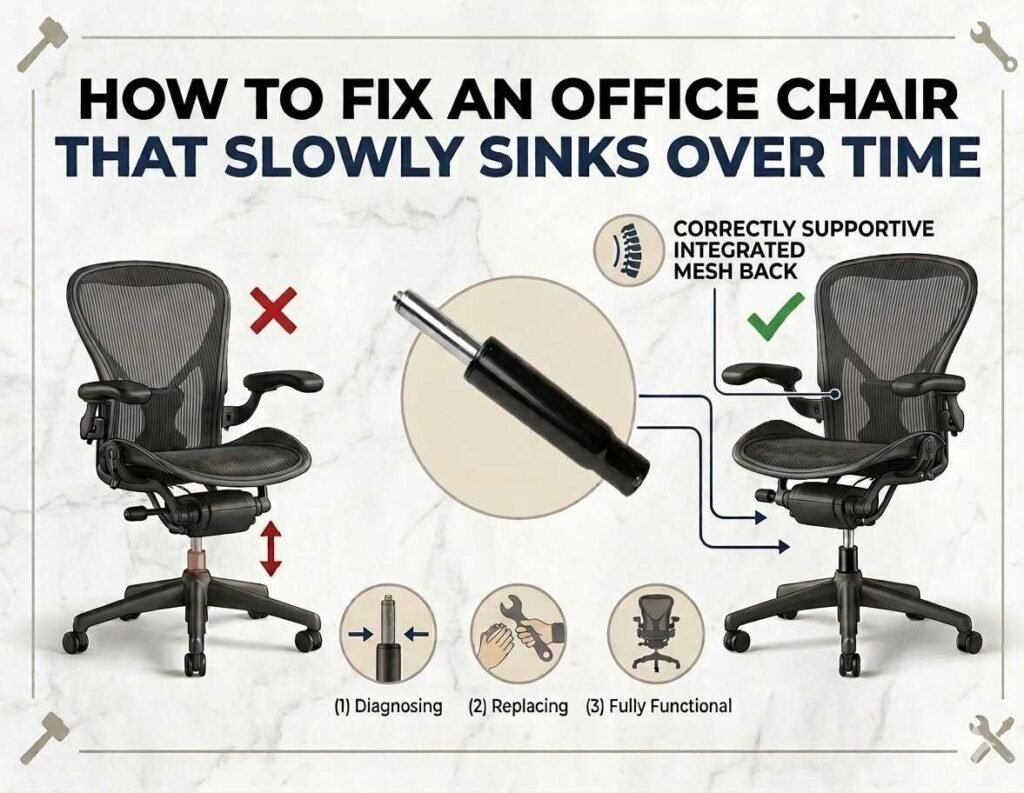
Every office chair with height adjustment has a gas cylinder inside the base. Pull the lever, and the chair moves. Release it; the chair locks. That’s the whole system.
What goes wrong is simple. There’s a small seal inside that cylinder that keeps everything in place. Over time that seal wears down, and the chair starts losing its hold gradually. That’s why it doesn’t drop all at once. It’s a slow leak, which is exactly why most people put up with it longer than they should.
Weight plays a role too. The more load the cylinder carries day after day, the faster that seal wears. Same model, two different people, two very different lifespans. Budget chairs tend to use lower-quality seals that give out sooner. A well-built commercial-grade chair, or a properly refurbished one, holds up considerably longer.
Signs Your Chair Needs Repair
Most people already know something’s wrong by the time they go looking for answers. A few patterns are worth naming clearly.
The most common: you sit down at the right height, get up two hours later, and the seat is lower than where you set it. You’ve turned the height lever into a reset button you hit several times a day. That’s the cylinder losing its ability to hold pressure.
A related symptom is when the lever adjustment loses its crispness. You pull it, adjust it, release it, and the seat drifts down anyway. The valve is working, but the cylinder can no longer hold pressure under your weight.
Sudden drops are a different sign altogether. If the chair sinks an inch in one movement rather than creeping gradually, the seal may have failed more completely, or there’s a separate fault in the lever mechanism. Sometimes you’ll feel extra wobble in the base alongside this as internal components shift inside the housing.
Any one of these signals means it’s time to do something about it.
How to Fix an Office Chair That Slowly Sinks
Fix #1: Use a Hose Clamp (Quick DIY Fix)
I’ve done this fix in parking lots. It takes two minutes, costs next to nothing, and genuinely works. The idea is simple: a hose clamp acts as a physical collar around the cylinder shaft, blocking the piston from sliding further down into the column.
What you need: Hose clamps sized to your cylinder shaft diameter and a flathead screwdriver.
Steps: Raise the chair to the height you want. Tilt the seat and find where the bare metal cylinder shaft shows between the seat plate and the outer column housing. Slide the clamp onto the shaft right where it meets the column, press it snug against the housing, and tighten it down with the screwdriver. The clamp physically stops any further descent.
Pros: Costs under $5, done in minutes, no disassembly required.
Cons: Your chair height is now locked wherever you set it. Height adjustability is gone. That’s fine if you’ve already dialed in your ideal sitting position and don’t share the chair with anyone else.
Fix #2: PVC Pipe Method (Budget Fix)
The PVC approach takes a bit more preparation but gives you a more stable result than a clamp alone. Rather than clamping to the shaft, you create a rigid sleeve around the cylinder that bears weight directly, transferring the load through the pipe to the column housing so the piston never has to move in the first place.
What you need: PVC pipe with an inner diameter slightly larger than your cylinder shaft, a hacksaw or pipe cutter, and a measuring tape.
Steps: Raise the chair to your desired height and measure the exposed shaft between the seat mechanism and the top of the outer column. That’s your pipe length. Cut, split lengthwise if needed for easier installation, and slide it around the shaft. When you sit, weight transfers through the seat plate, through the pipe, and into the column housing. The piston doesn’t move because it doesn’t have to.
Pros: Very stable, cheap, and you can shorten the pipe if you need to drop your height a little.
Cons: Like the clamp method, you’re giving up adjustability. Measure twice before cutting.
Fix #3: Replace the Gas Lift Cylinder (Best Long-Term Solution)
If the chair is worth keeping, this is the fix worth doing. Every other method on this list is a workaround. A new replacement cylinder is the only option that gets your chair functioning exactly as it was designed to.
What you need: A compatible replacement cylinder for your chair’s brand and model, a rubber mallet, a pipe wrench for stubborn connections, and a flat surface to work on.
Steps: Flip the chair upside down on a flat surface. The seat and mechanism pull away from the cylinder and base as one unit. The cylinder is press-fit into the star base, not threaded, so knock it upward from the base opening with the rubber mallet. Firm taps from below should release it. The top connection to the seat mechanism releases the same way. Pull out the old cylinder, press in the new one until it seats fully, reattach the seat mechanism, flip the chair upright, and test the height range.
Pros: Full restoration. The chair adjusts, holds position, and works like it did originally. A quality replacement cylinder handles several more years of daily use.
Cons: You need to be comfortable tipping the chair and working with a mallet. A seized cylinder can take real effort. If that’s not your comfort zone, Fix #5 is the better call.
Fix #4: Use a Cylinder Sleeve Kit
Think of this as the commercially packaged version of the PVC method. Cylinder sleeve kits are sold by office chair parts suppliers and are purpose-made for exactly this problem. They typically include a split-sleeve design that wraps around the shaft and is pre-drilled for a locking bolt and often come with multiple height options so you can choose from a few fixed positions rather than cutting custom ones.
They install cleanly and cost roughly $15 to $40. The limitation is the same as PVC: no on-the-fly height adjustment. Confirm sleeve diameter matches your cylinder before ordering.
Fix #5: Seek Professional Chair Repair
Some chairs need to go to someone with the right tools and the right experience. A seized cylinder that won’t budge, a chair with multiple mechanical issues beyond the sinking, or a premium ergonomic chair where the risk of DIY damage outweighs any savings—all of these are good reasons to call in a professional.
Too many quality chairs come through the shop after a DIY attempt cracked the column housing or pulled the press-fit loose. On a chair worth $800 or more, that’s avoidable and expensive. At Nulife, chair repairs are daily work, and the right tools make a difference.
Should You Repair or Replace Your Chair?
The honest answer here depends entirely on the chair you’re starting with.
A chair that cost under $150 new with wear showing in multiple places often isn’t worth repairing. Parts alone run $20 to $50, and labor adds to that quickly. A refurbished commercial-grade chair is worth pricing before you commit to fixing something that was never built to last.
A mid-range or premium ergonomic chair is a completely different story. Replacement cylinders for commercial-grade chairs run $30 to $80. Even with professional installation, you’re spending $80 to $150 to restore something that costs $600 to $1,500 new. A professionally refurbished Herman Miller Aeron or Steelcase Leap performs like new at 30 to 70 percent below retail. That’s a number worth knowing before writing off a quality chair.
How to Prevent Your Office Chair from Sinking Again
A few practical habits will keep your next cylinder lasting as long as it should.
Don’t exceed the weight capacity. That limit exists for a reason. Pushing past it shortens the cylinder seal’s life noticeably
Check it every couple of months. Sit down, raise the chair, and see if it holds. Catching a slow leak early means you fix it on your terms rather than when it finally gives out completely.
Match the replacement to the original spec. Off-brand cylinders with loose tolerances often fail within a year. The extra cost for a quality part is worth it, and make sure to confirm compatibility with your chair’s brand and model before ordering. Shaft diameters, travel lengths, and fittings are not standardized.
Test any DIY fix before trusting it. A hose clamp not fully tightened or a pipe cut slightly off can shift under load. A wobbly chair is more dangerous than one that just sinks. Always test with your full body weight before calling it done.
Handle the cylinder carefully. Gas lift cylinders hold real pressure. Never drill into, puncture, or cut one open, even when discarding it. During replacement, orient the chair so any unexpected release moves away from you.
Best Long-Term Solution: Upgrade to a Refurbished Ergonomic Chair
Plenty of chairs that come through with sinking problems were never built for the job. A basic task chair designed to a price point rather than a performance standard was never meant for eight-hour daily sessions. The cylinder failing is almost inevitable in that situation.
Professionally refurbished commercial ergonomic chairs are a different product category. These were originally built for corporate environments where durability isn’t optional. A proper refurbishment means a new cylinder, restored seat foam, a fully inspected mechanism, and every adjustment working as it should. Most come in at 30 to 70 percent below what the same chair costs new, which reframes the conversation for anyone who’s been assuming a quality ergonomic chair is out of reach.
There’s an environmental dimension worth noting here too. According to the U.S. Environmental Protection Agency, furniture represents a significant share of municipal solid waste generated each year in the United States. Keeping a well-built chair running for another decade is a straightforward way to avoid adding to that number.
Nulife refurbishes commercial ergonomic chairs with full inspection and parts replacement on every unit. If you’re weighing repair versus moving on entirely, comparing a refurbished option to your repair quote takes five minutes and often changes the decision.
Conclusion
Sinking chairs are fixable. The hose clamp handles it fast and cheap. PVC or a sleeve kit works for something cleaner without swapping the cylinder. Full cylinder replacement is the only fix that genuinely restores the chair. And if it was never the right chair to begin with, a refurbished commercial model is worth pricing out before you buy another budget seat and go through this again in two years.
Frequently Asked Questions
Don’t let a sinking chair ruin your productivity.
Get expert repair services, premium replacement parts, and refurbished ergonomic chairs at a fraction of the cost of new ones.